Top 5 Slack eDiscovery Tools 2025
Comparison of several of the top Slack eDiscovery tools that help IT professionals working on eDiscovery produce Slack data from either JSON archives or the Slack API.
Complete guide to Slack eDiscovery: preserve threaded conversations, attachments, emoji reactions. Learn legal hold procedures and advanced search tools.


Slack is used by over 1 million organizations, including at least partial use, via Slack Connect, of 77% of Fortune 100 companies. While Microsoft Teams still dominates day to day communication in large organizations, how we communicate at work has fundamentally shifted from the traditional back-and-forth of corporate email. Most corporate conversations - whether humdrum or sensitive - happen on the company's instant messaging platform. (If you're showing as a "Green Bubble", that means you're available and at your computer!) Given this rise, legal teams have had to adapt. The challenge of collecting evidence from Slack workspaces is that there is a much higher volume of messages, and that there are additional layers of context that now matter.
I had lunch this week with the managing partner and eDiscovery practice head of a law firm in Lake Oswego, Oregon. He asked about what kind of product we built, and his first reaction was:
"Ah, you guys have figured out Slack, huh!"
This isn't a phrase you would hear when discussing eDiscovery of emails or PDF documents. As my lunch partner and I knew, Slack data is uniquely challenging to access and review for legal discovery, in comparison to the data you can export from Google Vault or Microsoft Purview. How is this the case?
Unlike email, where messages exist as discrete formal communications, Slack is a collaborative environment where context matters as much as content. Enterprise use of the platform generates massive amounts of data, including public and private channel messages, "direct" messages sent from one person (a "custodian", in legalese) to another, group messages with multiple people involved, threads (messages that are sent in response to another message, and "threaded" visually), files of all kinds, links to websites, emoji reactions, and attachments. Emails and paper documents never had the equivalent of a "thumbs up" reaction to a significant decision that was communicated in writing. Nor, until recently, had the email equivalent existed of a "laughing" emoji in response to what should not have been a laughing matter, outside the confines of the water cooler.
The informal, real-time nature of Slack communication means that legally relevant information often appears scattered across multiple channels, embedded within lengthy threads, or expressed through seemingly casual interactions. And unlike emails, which generally cannot be deleted or modified once sent, Slack messages can and routinely are - often without their senders or recipients realizing that such deletions and edits themselves can be tracked, and sometimes constitute evidence in and of themselves.
Cost is one big upshot of this challenge. The volume of Slack data, and all of these new layers of context, make initial review the costliest phase of discovery. According to a Minnesota State white paper, merely uploading a 200-gigabyte (GB) Slack export file to Relativity, a popular legal technology company's flagship eDiscovery platform, can run you $12.90 per gigabyte, per month in hosting fees alone. I routinely hear about Relativity hosting fees per case or per year, depending on the size of the corporation orlaw firm, that run into the tens or hundreds of thousands of dollars. Added to this figure is the cost of someone, whether outsourced or on your payroll, to sift through the JSON archives that Slack gives you to find the data in scope. The whole thing becomes a bear of a task, and project delays and cost overruns are rampant. If you're a law firm, your client is counting on you to bill appropriately. If you're the client representative, you want to make sure your law firm and their ALSP are using secure technology to find what they need quickly, so they don't simply burn hours scrolling through file after file of raw JSON in a ZIP archive.
Let's talk about what makes slack eDiscovery distinct from traditional discovery, the eDiscovery tools and strategies that make it effective, and why understanding context—not just information—is critical for legal compliance and litigation readiness.
Many organizations begin their slack eDiscovery process with standard Slack export files. These exports are provided by Slack in JSON format,. Depending on your organization's plan, getting private and direct messages included in these exports might require a hand-submitted request to Slack, followed by an approval process on their end. These export 'archives' contain comprehensive communication data but require specialized tools to transform them into legally useful formats.
Slack export files include:
The challenge lies in making this data accessible and searchable for legal review.

For anything beyond a very simple matter, you'll probably need a third party tool in addition to Slack's own functionality.
How much eDiscovery you can do with Slack depends heavily on your plan:
Slack eDiscovery requires putting information and communication in context. Without this valuable context, information can be misleading or so incomplete that it becomes meaningless. Consider a message that simply says "approved" in a channel. Without the threaded conversation that preceded it (in that channel or others!) the attachment that was shared, or the reactions from other team members, this single word provides little value for legal proceedings.
This context includes:
Slack's threaded conversation feature allows users to respond to specific messages without cluttering the main channel. For slack eDiscovery tools, preserving these thread relationships is crucial. A message thread might contain the entire decision-making process for a business deal, regulatory compliance discussion, or employment matter.

Ensure that your discovery process captures not just the parent message, but all threaded replies, maintaining the chronological order and relationship between messages. This requires specialized tools that understand Slack's data structure and can present threaded conversations in a readable, legally defensible format. Or, if you have a large team that can handle the tedium, you can construct a similar record without a tool, provided that chain of custody is recorded sufficiently.
Slack conversations frequently include file attachments, document links, and integrations with other business tools. These elements often contain the most legally relevant information, yet they can be easily overlooked in basic export processes.

Effective tools:
While they might seem trivial, emoji reactions in Slack can carry significant legal weight. A thumbs-up reaction to a message about a business decision could indicate approval or agreement. Multiple team members reacting with specific emojis might demonstrate consensus or concern about a particular issue. The legal significance of emoji reactions has gained recognition in court proceedings, with some courts acknowledging emoji as legally significant indicators of agreement or intent. Preserving reaction data must be part of a comprehensive Slack legal hold process.

Modern eDiscovery tools capture reaction metadata, including who reacted, when, and with which emoji, preserving this information for potential legal relevance. Given the informal nature of Slack communication, these seemingly casual interactions often provide crucial evidence of decision-making processes and organizational consensus.
How do you find and filter through all of the scoped messages and their context without legal costs spiraling out of control?
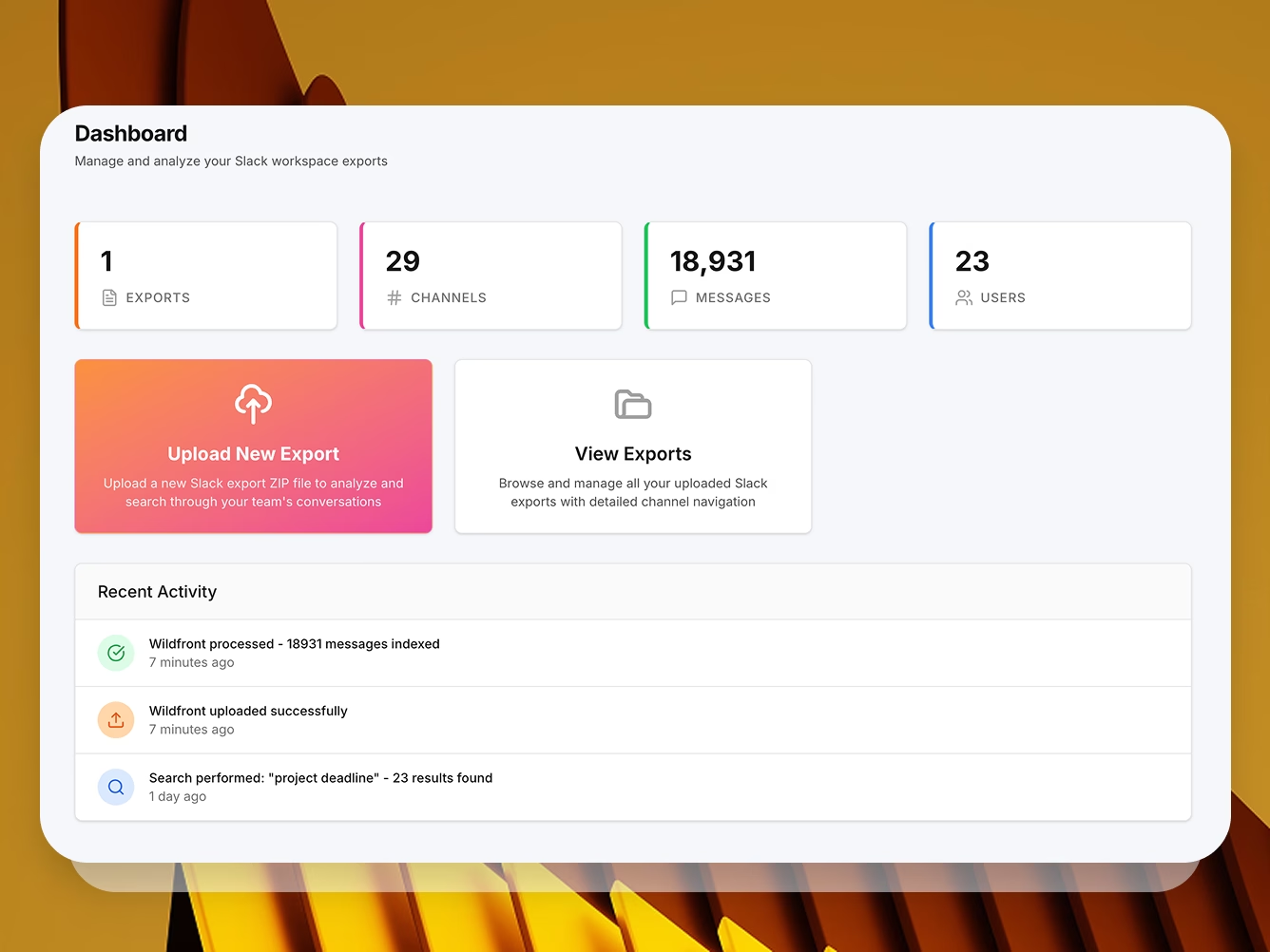
1. Early Case Assessment: Use dedicated Slack eDiscovery tools to recreate searchable chat archives but make sure that the chosen eDiscovery software does not invalidate chain of custody, and keeps metadata intact. Don't rely on the free "I found this on Github" repo to do this job. You'll need advanced filtering and search capabilities to quickly identify potentially relevant communications before full review begins. If you'd like to evaluate ViewExport, our tool can help you with this.
2. Automated Processing: Automatically organize, categorize, and present Slack data in reviewable formats, reducing manual processing time. The brute force method of redacting JSON files manually and adding them to a OneDrive folder won't work here.
3. Strategic Scoping: Carefully define the scope of discovery to focus on specific channels, users, and time periods most likely to contain relevant information. You'll sometimes want to scope a broader time frame in your initial request to Slack, knowing that you can use ViewExport or another eDiscovery tool to further narrow down when doing individual searches.
4. Technology-Assisted Review: With proper privacy and data storage procedures in place, AI and machine learning capabilities can identify patterns and prioritize documents for human review. For example, it's extremely helpful to simply ask the question, "Did James and Alice have an inappropriate workplace relationship?" rather than scrolling through all of the conversations, threads, and Group DMs that James and Alice were both part of. Technology can not only reduce false positives but can also find and attach context for you.
The informal nature of Slack communication requires sophisticated search strategies. Legal teams benefit from developing comprehensive lexicons of trigger words that account for casual language, industry jargon, and colloquialisms that might indicate legally relevant discussions.
These lexicons should include:
When dealing with extensive Slack archives, traditional keyword searches can become overwhelming and inefficient. Retrieval Augmented Generation (RAG) technology can help, provided the implementation is secure and private.
RAG combines the power of large language models with targeted retrieval from specific data sets. Compared to something like ChatGPT? A RAG is faster, more accurate, less imaginative, and doesn't require data to be uploaded to OpenAI's servers. In the context of Slack eDiscovery, RAG can:
This technology becomes particularly valuable when combined with filtering capabilities that allow legal teams to focus their search on specific date ranges, users, channels, or direct messages.
When litigation or regulatory investigation becomes reasonably anticipated, organizations must immediately implement Slack legal hold procedures. Slack's dynamic environment requires prompt action to prevent data loss through routine deletion, editing, or channel archiving.
Effective legal hold procedures include:
Regardless of the data collection method used, organizations must maintain detailed documentation of their legal hold processes. This includes:
Teri Maltais, VP at iTacit, compliance software for frontline employees, shared that
"Slack data shows up in investigations far more often now. What I've found is that HR and legal teams need a clean workflow or things get messy fast. Most organizations follow a simple chain of custody: export the relevant channels through Slack's compliance tools, log who pulled the data, and store the export in a restricted folder where access is tracked. Many teams outsource the review to an eDiscovery partner because Slack threads, reactions, and DMs can be hard to piece together manually. The volume has absolutely increased in the last two to three years as more frontline and hybrid teams rely on chat for real decisions. Clear documentation is what protects everyone."
This simple chain of custody is common, but it's also important to keep in mind that tracking who accesses a restricted folder can be difficult without a robust audit logging solution in place. Confirm with legal whether the system you intend to use has a good enough chain of custody log, with a test run: export a Slack archive, store it in a restricted folder, and show the file access logs to legal for review. As Teri notes, clear documentation is your best protection against a judge suppressing evidence in your case.
Organizations should establish clear Slack usage policies before eDiscovery needs arise. These policies should address:
Legal teams, IT administrators, and end users all play crucial roles in effective Slack eDiscovery. Regular training should cover:
Before relying on any slack eDiscovery tools in actual legal proceedings, organizations should conduct thorough testing to ensure:
The integration of AI and machine learning technologies continues to evolve in the eDiscovery space. For Slack discovery, these technologies offer particular promise in:
Whether you're setting your department up for future success or dealing with a current, pressing legal matter, we hope it's now clear: to scope, find, redact, preserve, and produce Slack ESI from a much higher volume of messages than email, including relevant context, you'll need to upgrade your approach. The threaded nature of Slack conversations, the informal communication style, and the rich metadata associated with reactions, attachments, and edits all contribute to the complete picture that legal teams need.
Ready to transform your Slack eDiscovery process? ViewExport provides the specialized tools and expertise needed to convert Slack export files into defensible, searchable legal intelligence. Our platform preserves critical context while streamlining your review workflow, ensuring you never miss the details that matter most while controlling costs through efficient data processing.
Contact ViewExport today to learn how our Slack eDiscovery solutions can enhance your legal team's efficiency and effectiveness. Or, just sign up for an account online if you don't want to wait.